
THE LUMIÈRE JOURNAL / FORMULA NOTES
The Science Behind Clear Complexion
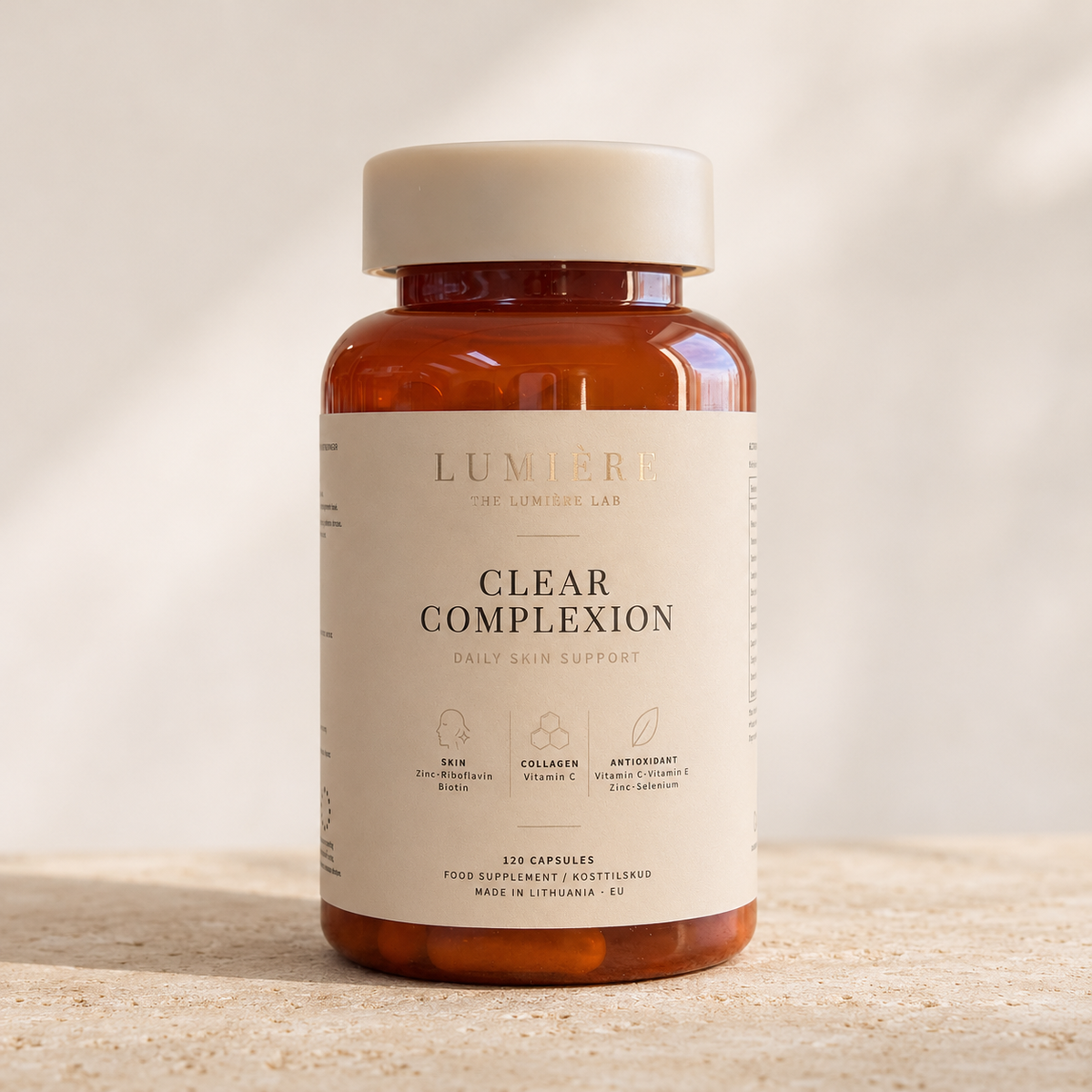
I know what it feels like to look at your skin and immediately start looking for the next thing to try. That experience is part of why I built Lumière. But it also made me care about a different question: what can we actually say about the ingredients?
Because a convincing ingredient list and convincing evidence are two different things.
Clear Complexion brings myo-inositol together with vitamins and minerals in one daily formula. This is the thinking behind it, the roles of the nutrients, and the limits I think we should be honest about.
THE SHORT VERSION
Clear Complexion at a glance
12 active ingredients. Amounts per daily serving of four capsules.
Skin, collagen & cell protection
- Niacin (nicotinamide) 200 mg NE
- Contributes to the maintenance of normal skin.
- Vitamin C 120 mg
- Contributes to normal collagen formation for the normal function of skin.
- Vitamin E 12 mg α-TE
- Contributes to the protection of cells from oxidative stress.
- Zinc 8 mg
- Contributes to the maintenance of normal skin.
- Riboflavin (B2) 2.1 mg
- Contributes to the maintenance of normal skin.
- Selenium 55 µg
- Contributes to the protection of cells from oxidative stress.
- Biotin 100 µg
- Contributes to the maintenance of normal skin.
The wider formula
- Myo-inositol 1,500 mg
- The largest active by amount in the formula.
- Pantothenic acid 300 mg
- Contributes to normal energy-yielding metabolism.
- Copper 1 mg
- A trace mineral included in the wider formula.
- Chromium 40 µg
- A trace mineral included in the wider formula.
- Vitamin D3 25 µg
- The form of vitamin D included in the blend.
Why I wanted to build this.
For a long time, the way I thought about skin was almost entirely external. A new cleanser. Another active. A routine with more steps than I really wanted.
I still care about skincare. I also became interested in nutrition, and in understanding the difference between what a nutrient normally does and what a particular supplement has actually been shown to do.
That distinction shaped Clear Complexion. I wanted a formula you could understand without needing to decode a proprietary blend. You should be able to see what is in it, how much is there, and which statements are supported.
Every active. Every dose. And an honest explanation of what we know.
A longer ingredient list is not automatically a better one. And a bigger number on a label is not automatically a better result. Transparency means giving you the information to look beyond both.
The nutrients with a recognised role in skin.
Zinc · 8 mg per daily serving
Zinc contributes to the maintenance of normal skin. This is an authorised nutrient health claim, supported by EFSA's assessment of the evidence.
The word normal matters here. It describes a nutritional role. It does not promise a particular change in your appearance, or tell us that everybody needs additional zinc.
That is how I want us to talk about it: clearly, without turning a recognised function into a bigger promise.
Riboflavin · 2.1 mg
Riboflavin is vitamin B2. It also contributes to the maintenance of normal skin. Alongside zinc and biotin, it is one of the nutrients behind the skin wording you see on our label.
It may be less familiar than the ingredients that usually dominate skincare conversations. That does not make its normal nutritional role less relevant.
Biotin · 100 µg
Biotin contributes to the maintenance of normal skin. The daily serving contains 100 µg, and that amount is disclosed rather than hidden inside a blend.
I would not interpret this as “more biotin means better skin”. An established nutrient function is not a dose-response promise for someone whose intake is already sufficient.
Niacin · 200 mg NE
Niacin is vitamin B3; the formula uses nicotinamide. Niacin contributes to the maintenance of normal skin, too.
It is worth being precise about the form of the research. A study involving an ingredient in a cream does not establish what happens when you swallow that ingredient. The route of use is part of the evidence, not a detail we can leave out.
The quantity is expressed as niacin equivalents, or NE. You can find it alongside every other active in the formula below.
Collagen formation, without the collagen confusion.
Clear Complexion is not a collagen powder. It contains vitamin C: 120 mg per daily serving.
Vitamin C contributes to normal collagen formation for the normal function of skin. That is the specific relationship we refer to. It does not mean that Clear Complexion contains collagen, and it is not a promise about wrinkles or visible changes.
I like making that distinction because it makes the product easier to understand. You know what the ingredient is, and what the statement actually refers to.
And what does “cell protection” mean?
Vitamin C, vitamin E, zinc and selenium contribute to the protection of cells from oxidative stress. The daily serving provides vitamin E at 12 mg α-TE and selenium at 55 µg, alongside the vitamin C and zinc already mentioned.
These are recognised nutrient functions. We do not use them to imply that a capsule can cancel out a demanding week, replace sleep, or substitute for a varied diet.
The full formula, with nothing hidden.
All amounts below are per recommended daily serving of four capsules.
| Active ingredient | Daily amount |
|---|---|
| Myo-inositol | 1,500 mg |
| Niacin | 200 mg NE |
| Pantothenic acid | 300 mg |
| Vitamin C | 120 mg |
| Vitamin E | 12 mg α-TE |
| Zinc | 8 mg |
| Riboflavin | 2.1 mg |
| Copper | 1 mg |
| Selenium | 55 µg |
| Chromium | 40 µg |
| Vitamin D3 | 25 µg |
| Biotin | 100 µg |
Why show myo-inositol separately?
Because it is an ingredient in the formula, and transparency means disclosing it. Clear Complexion contains 1,500 mg of myo-inositol per daily serving.
That disclosure is not a specific skin, hormone or metabolic claim. Research on myo-inositol needs to be read in the context of the participants, the dose, the other ingredients and the outcome measured. I do not want a paper about a different population to become an implied promise about your skin.
And the other nutrients?
Pantothenic acid, copper, chromium and vitamin D3 complete the formula alongside the ingredients discussed above. Their inclusion does not mean each one has a separate skin claim.
For example, pantothenic acid contributes to normal energy-yielding metabolism. That is a different statement from a skin-specific claim, and we should keep those two things separate.
The complete label is the place to check the ingredient forms, directions and warnings. This article explains the thinking; it does not replace that information.
How I read the science.
When I read a paper, I try to answer five questions before thinking about what it means for a formula.
- What was actually tested? An isolated nutrient, a combination, a cream or an oral supplement?
- Who was studied? Healthy adults, people with a diagnosed condition, or a laboratory model?
- At what dose? An ingredient name alone does not establish a match.
- What changed? A laboratory marker is not automatically a visible or meaningful benefit.
- How strong is the wider evidence? One interesting result is a starting point, not the whole answer.
EFSA scientific opinions are useful because they assess evidence behind particular nutrient relationships. An authorised claim is still subject to conditions of use. It is not an endorsement of a specific brand.
The sources below concern individual nutrients. They are not clinical trials of the finished Clear Complexion formula. I do not want us to blur that line just because “clinically proven” would look good in a headline.
A routine you can actually understand.
The serving is two capsules twice daily, preferably with a meal, following the label. A bottle contains 120 capsules: a 30-day supply.
Keep it simple. Pick a routine you can remember, check what else you are taking, and follow the recommended serving. Do not increase the dose in an attempt to get a faster result.
Clear Complexion is a food supplement. It complements a varied and balanced diet and a healthy lifestyle; it does not replace them. If you need individual advice about medicines, pregnancy, breastfeeding or a health condition, speak to a qualified healthcare professional.
My aim is that you can finish this article knowing exactly what Clear Complexion contains, which nutrient functions we are talking about, and where the information comes from.
That is what a formula you can get to know should look like.
Open the sources yourself.
The references are grouped by the nutrient relationship they assess. A paper's title may mention several proposed claims; that does not mean all of those claims were accepted. Read it alongside the authorised EU wording.
- EFSA · Zinc and normal skin (2010) ↗
- EFSA · Riboflavin and normal skin (2010) ↗
- EFSA · Biotin and normal skin (2010) ↗
- EFSA · Vitamin C, collagen and oxidative protection (2009) ↗
- EFSA · Vitamin E and oxidative protection (2010) ↗
- EFSA · Selenium and oxidative protection (2009) ↗
- EFSA · Zinc and oxidative protection (2009) ↗
- EFSA · Niacin and normal skin (2009) ↗
- EFSA · Pantothenic acid and normal energy-yielding metabolism (2009) ↗
- European Union · Authorised health claims, Regulation 432/2012 ↗